📚 Referee Service
I have served as a referee for manuscripts submitted to the following journals:
- npj Quantum Information
- Physical Review X
- Physical Review Letters
- Physical Review B

I have served as a referee for manuscripts submitted to the following journals:
Talks
♦ denotes an invited talk
Short description of portfolio item number 1
Short description of portfolio item number 2
Christopher Fechisin, Kunal Sharma, Przemyslaw Bienias, Steven L. Rolston, J. V. Porto, Michael J. Gullans, Alexey V. Gorshkov
Rydberg arrays exhibit remarkable many-body physics due to strong Rydberg-Rydberg interactions which are possible between their constituent atoms. We present a protocol which leverages this physics to non-destructively count photons by temporarily storing them in the array.

Christopher Fechisin, Nathanan Tantivasadakarn, Victor V. Albert
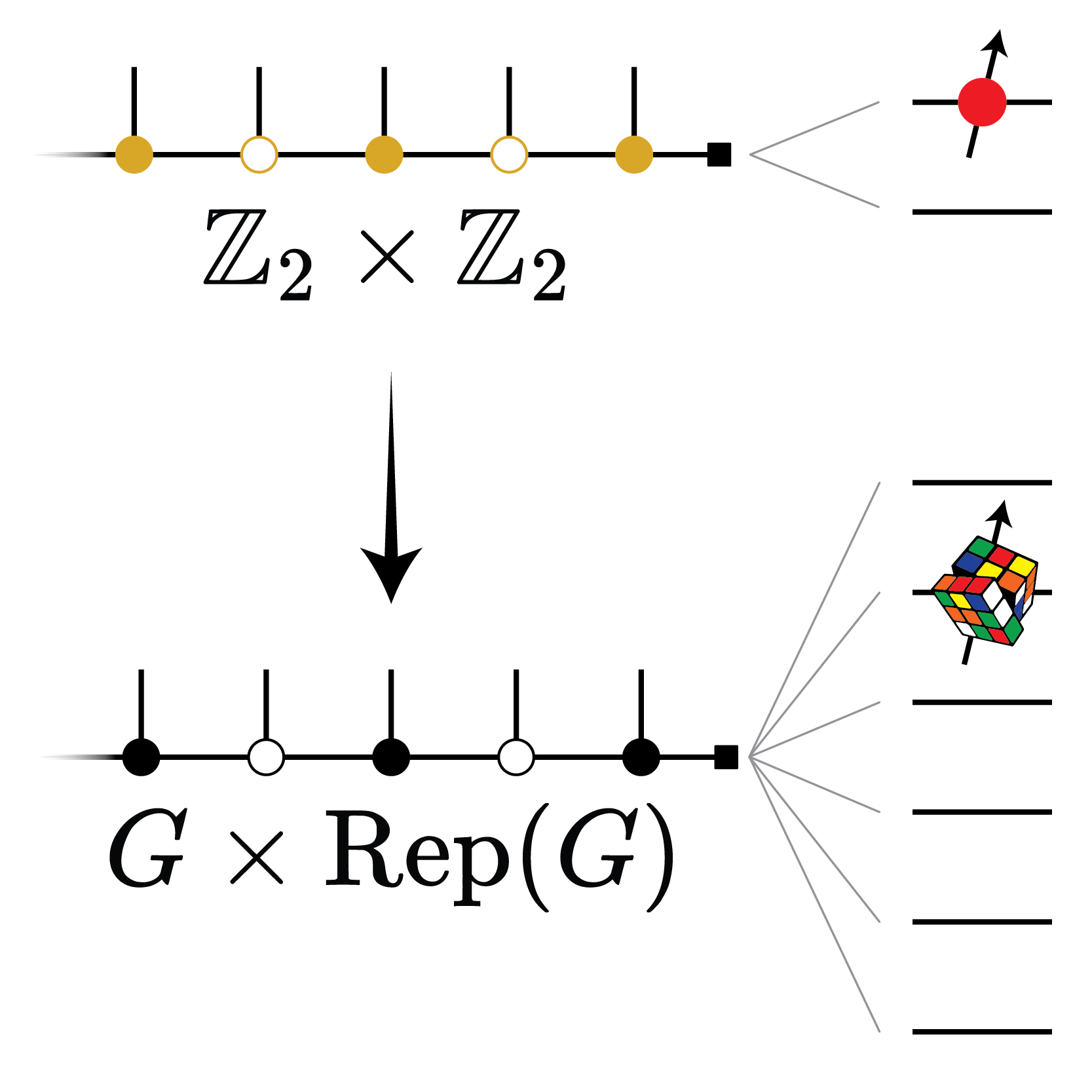
The cluster state is the simplest example of SPT order, protected by a $\mathbb{Z}_2\times\mathbb{Z}_2$ symmetry. In this work, we show that a generalized cluster state with fusion category symmetry $G\times\text{Rep}(G)$ shares many qualitative features with the ordinary cluster state and should be thought of as an SPT protected by a non-invertible symmetry.
Jeet Shah, Christopher Fechisin, Yu-Xin Wang, Joseph T. Iosue, James D. Watson, Yan-Qi Wang, Brayden Ware, Alexey V. Gorshkov, Cheng-Ju Lin
In this work, we interrogate the analogy between (i) pure state SPTs as ground states of local Hamiltonians and (ii) mixed state SPTs as steady states of local Lindbladians. We construct a Lindbladian which hosts a simple mixed-state SPT within its steady-state subspace, then add symmetric local perturbations to see if the new steady states lie in the same mixed-state phase as the original. We find that for generic symmetric perturbations, the answer is no, due to the onset of strong-to-weak spontaneous symmetry breaking.
Maissam Barkeshli, Christopher Fechisin, Zohar Komargodski, Siwei Zhong
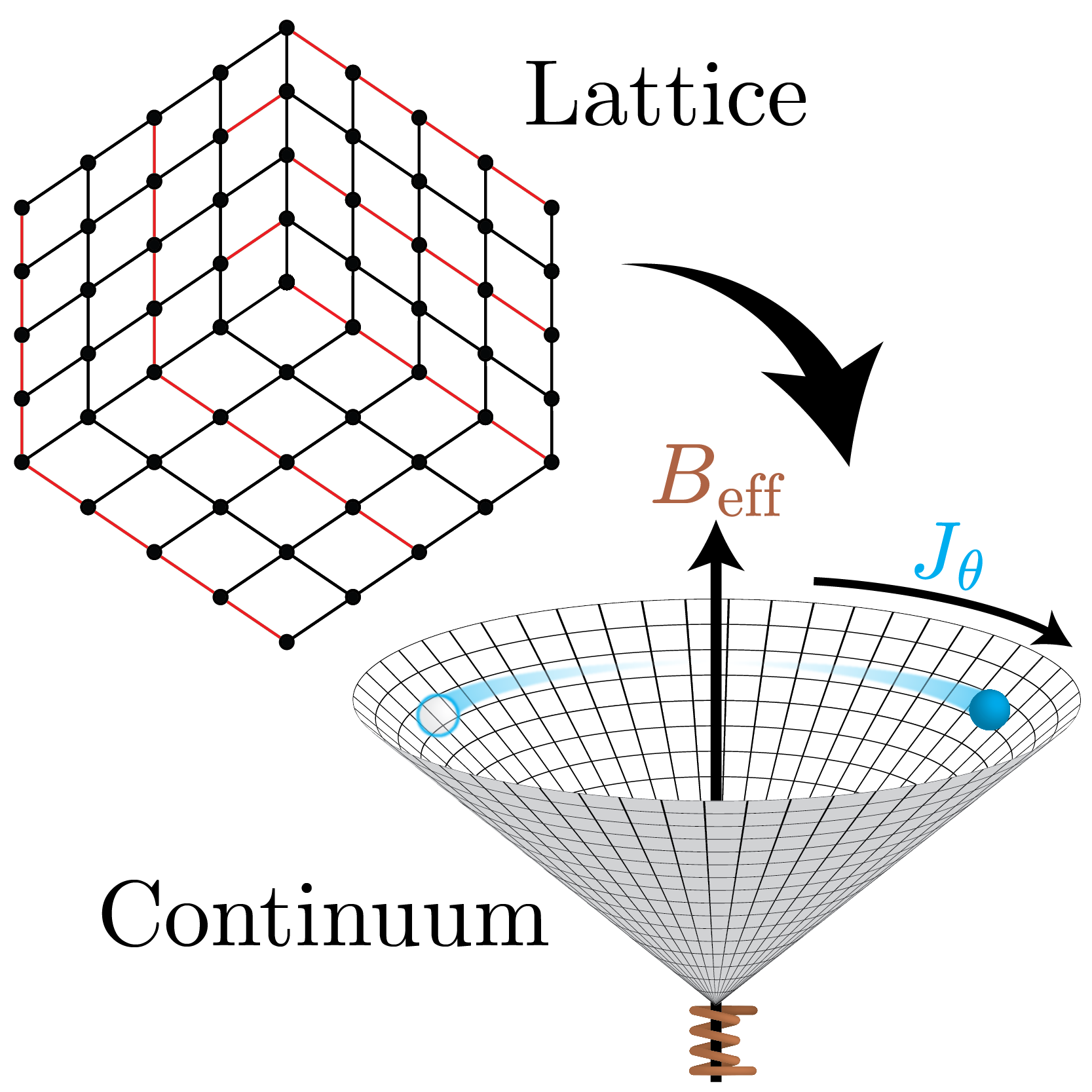
We study the effects of lattice rotational and translational symmetries on Dirac cones in lattice models and the Dirac fermion field theories to which they flow in the continuum. In particular, we find that models defined on lattices with defects flow to field theories with additional magnetic flux, the amount of which is determined by universal topological data. We use defect conformal field theory to identify observables sensitive to this additional flux and then measure it in critical lattice models.
Christopher Fechisin, Jeet Shah, Tsung-Cheng Lu, Zhi-Yuan Wei, Yu-Xin Wang, Alexey V. Gorshkov, Cheng-Ju Lin
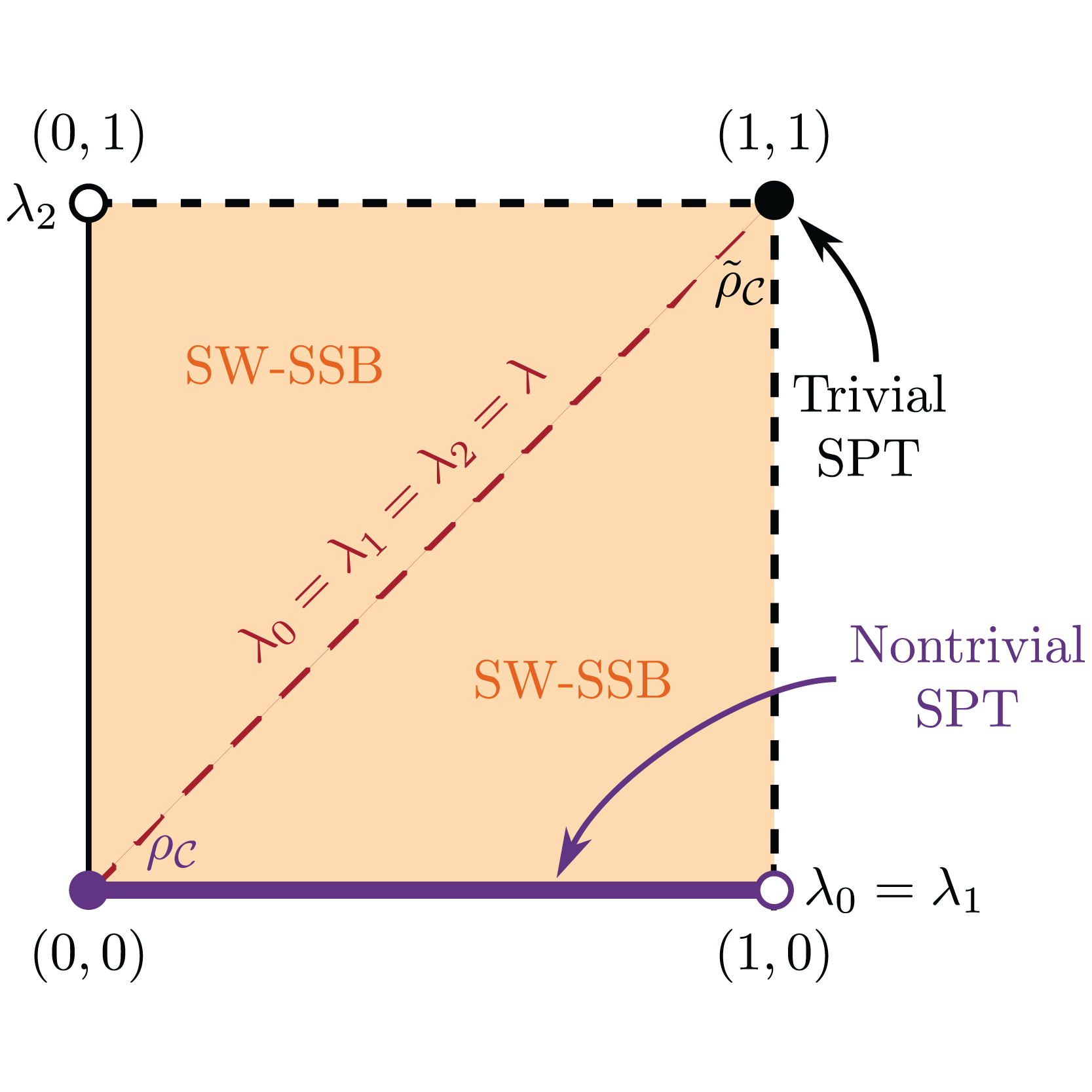
Open quantum systems can exhibit inherently mixed quantum orders, such as strong-to-weak spontaneous symmetry breaking (SW-SSB), which have no analogue in pure states. It is generally expected that a finite-depth local quantum channel cannot induce a phase transition to SW-SSB in one spatial dimension. We circumvent this obstruction by applying a long-range quantum channel to a family of pure states, finding trivial, mixed SPT, and SW-SSB phases in various parameter regimes.
Christopher Fechisin, Kieran Cooney, Mathi Raja, Kyle Kawagoe, Victor V. Albert, Dominic Williamson, Seth Musser
We introduce a stabilizer formalism based on the Clifford hierarchy, which generalizes the Pauli stabilizer formalism by combining Pauli-X operators with diagonal operators drawn from a fixed level of the Clifford hierarchy on prime-dimensional qudits. This yields a natural class of beyond-Pauli stabilizer models, including many twisted quantum double phases. Using this framework and focusing on a minimal example, we construct a logical qudit and an explicit non-Clifford transversal logical gate.
Undergraduate course, University 1, Department, 2014
This is a description of a teaching experience. You can use markdown like any other post.
Workshop, University 1, Department, 2015
This is a description of a teaching experience. You can use markdown like any other post.